
Off-grid solar planning
A solar array starts with the energy you use, not a panel count. This guide turns daily loads, local solar conditions, equipment limits, and mounting space into a sizing checklist you can verify against real component documentation.
To size solar panels, first total the watt-hours your loads use in a day. Then divide that demand by the peak-sun-hours for your location and check the result against the voltage, current, battery, inverter, and mounting limits in the actual equipment documentation. A panel count is the last step, not the first.
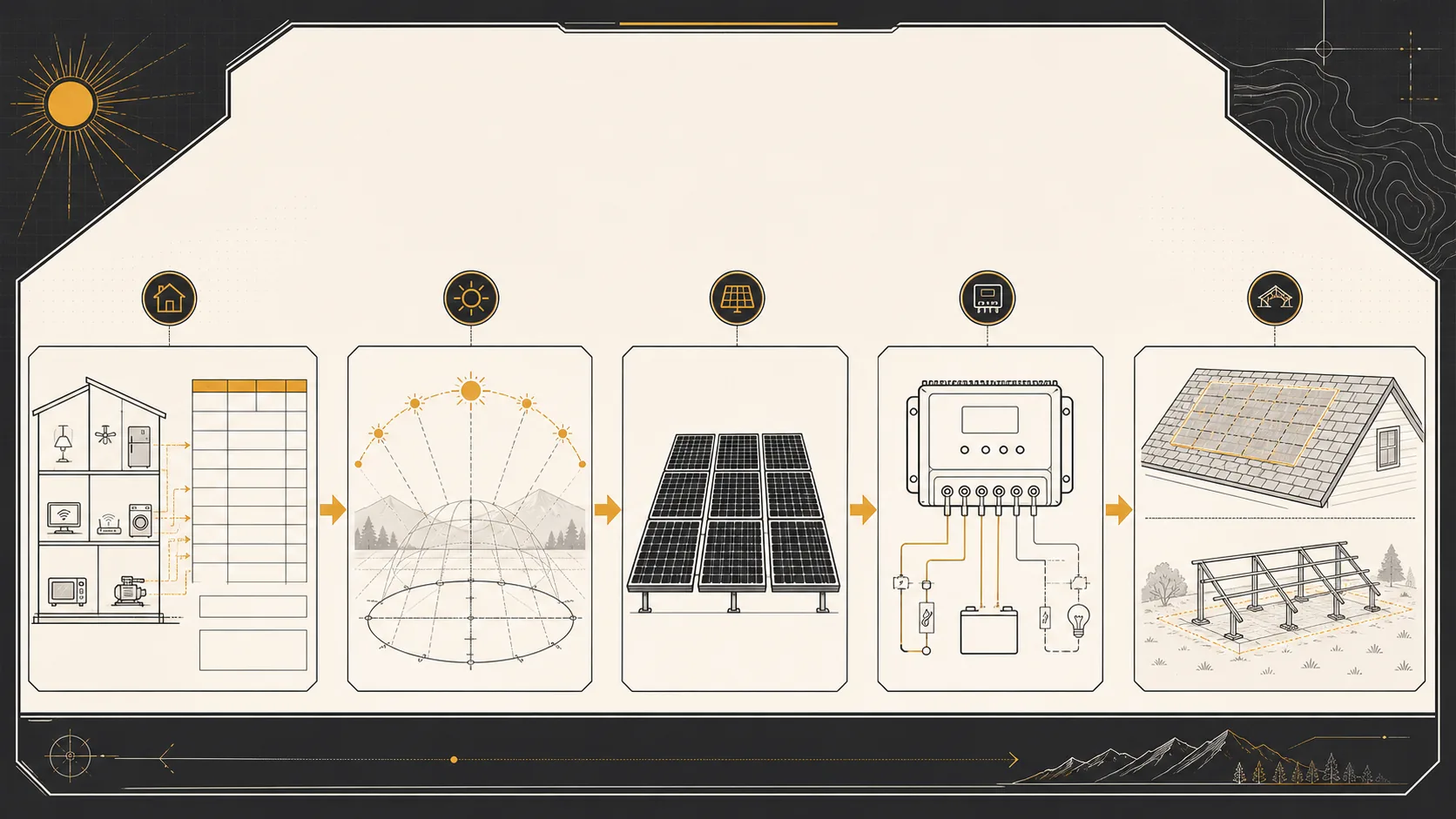
What size solar panel array do you need?
The right array size is the one that can support the daily energy target you documented under the solar conditions you actually have. Start with daily watt-hours. Divide by the relevant peak-sun-hour estimate. Then validate the preliminary array against your charge controller, battery, inverter, and mounting plan.
This is deliberately a system calculation. A module’s nameplate wattage is a test rating, while delivered energy changes with location, season, orientation, temperature, shading, wiring, and the rest of the system. Do not substitute a generic panel-count rule for the datasheets and local production estimate.
Step 1: Turn every load into daily watt-hours
Daily watt-hours are the cleanest starting point because they connect the appliance side of the system to the solar side. For each load, record its power draw in watts, the hours it runs in a day, and whether it cycles. Multiply watts by hours, then total the entries. A device with a high nameplate rating may use little energy if it runs briefly; a modest continuous load can dominate the daily total.
| Load-table field | What to record | Why it matters |
|---|---|---|
| Device or circuit | The actual item being powered | Keeps the estimate tied to a real use case. |
| Watts | Nameplate or measured draw | Provides the power input for the calculation. |
| Hours per day | Typical and high-use cases | Turns power into daily energy. |
| Duty cycle | For loads that turn on and off | Avoids treating intermittent loads as continuous. |
| Seasonal use | Heating, cooling, pumping, or other changes | Shows when the design case changes. |
For a cabin, RV, or backup circuit, write down the design day rather than an average day. The design day is the day the system must carry without disappointment. If you do not have measured data, label the assumption and replace it when you do.
Step 2: Match the array to your local solar window
Peak sun hours are a planning input, not the number of daylight hours. They express solar energy for a location as an equivalent number of hours at standard peak irradiance. A site with a long summer day can still have a different production profile than another location with the same daylight duration.
Use a named location tool rather than a national average. The NREL PVWatts Calculator is a public starting point for estimating photovoltaic energy production from location and system assumptions. Keep the assumptions visible: tilt, azimuth, shading conditions, and the month or season you are trying to cover all change the result.
For resilience planning, the weak season can matter more than an annual average. That does not mean every system must be built for the same autonomy target. It means the owner should select the design condition explicitly: occasional summer use, year-round cabin use, or a backup system with a defined critical-load list are different jobs.
Step 3: Convert array capacity into panel count and mounting area
Once the preliminary array capacity is known, divide it by the rated wattage of the module you are actually considering. That produces a starting panel count. Next, use that module’s datasheet for its dimensions, electrical ratings, and mounting requirements. Do not assume two modules with the same watt rating take the same space or have the same electrical limits.
Physical layout is a real constraint. Roof penetrations, setbacks, walkways, rack geometry, wind considerations, cable routes, and shade can change the usable area. Ground mounts add their own site and structure decisions. A layout that works on paper but does not fit the mounting surface is not a finished sizing calculation.
Electrical layout also matters. Modules wired in series increase voltage; modules wired in parallel increase current. The correct configuration depends on the PV input range and current limits documented for the selected charge controller or inverter. That check belongs before the order, not after the panels arrive.
Step 4: Check the controller, battery, and inverter limits
Panel sizing is not a standalone shopping filter. The controller is often the constraint that decides whether a proposed electrical layout is viable. The array has to fit the rest of the system. Read the PV-input voltage and current limits for the charge controller or hybrid inverter. Read the battery documentation for its charging requirements and operating limits. Compare the inverter’s continuous and surge capability against the loads you intend to run.
| System part | Document to check | Question to answer |
|---|---|---|
| PV module | Module datasheet | What are the rated electrical values and physical dimensions? |
| Charge controller or hybrid inverter | Installation manual and specifications | Does the proposed series/parallel array stay within PV voltage and current limits? |
| Battery bank | Battery manual | What charging and operating limits apply to the selected battery? |
| Inverter | Inverter specification sheet | Can it support the planned continuous and starting loads? |
| Mounting system | Engineering and installation guidance | Does the planned surface and rack support the required layout? |
The U.S. Department of Energy’s Solar Energy Technologies Office provides public background on solar technologies. For a purchase decision, the controlling sources remain the documentation for the exact components and the local installation requirements.
[A VERIFIER]. A design consultation should resolve an unknown constraint before a system is ordered.What changes for an RV, cabin, or backup system?
Mobile systems usually face stricter mounting-area limits and a changing solar window. Cabins may have seasonal occupancy and long periods with little load. Backup systems begin with the critical circuits that must run during an outage, not every circuit in the house. The calculation framework stays the same; the load profile and the design condition change.
If you are moving from a worksheet to equipment selection, compare the categories in the solar panel collection only after you have a documented energy target and compatible system limits. An authorized retailer or installer can review the component set where the documentation leaves a gap.
Common solar array sizing mistakes
Using daylight hours instead of peak sun hours
Daylight describes how long the sun is above the horizon. Peak sun hours are an energy-equivalent planning metric. Use location-specific production inputs instead of substituting one for the other.
Assuming panel watts equal daily delivered energy
Rated module watts do not state how many watt-hours the array will deliver at a particular site. Production depends on the local solar resource and the documented system assumptions.
Letting inverter size choose the array size
An inverter rating describes the loads it can support under specified conditions. It does not, on its own, define the solar array. Start with energy use and then verify that every component fits the planned system.
How residential and commercial projects differ
Residential homes, seasonal cabins, and commercial facilities can use the same sizing method, but their factors are different. A residential roof may have smaller available space and a household load profile. A commercial roof can have a larger area, more square footage, different structural requirements, and a different electricity demand. In both cases, determine the load target before comparing panel sizes.
Panel cells convert sunlight into electrical output. Cell efficiency is one factor that affects how much rated wattage fits into a module footprint, but it does not replace the module datasheet. Module dimensions, weight, mounting requirements, and the roof or ground area all weigh into the installation plan. More efficient modules can be useful where space is tight; they are not automatically the lower-cost option.
For example, two available modules may have similar rated power but different dimensions, weights, or electrical characteristics. A larger module can reduce the number of modules in an array while increasing handling and mounting considerations. Smaller modules can make a constrained layout easier. Depending on the system, roofs, rack geometry, cable routing, and access can determine which option is practical.
These systems usually produce usable electricity only when the selected components and installation conditions match. Higher-output module sizes may change the layout, but they do not remove the compatibility check. Consider local weather, typical seasonal use, and whether the project is based on an annual average or a conservative low-sun period. Always install equipment according to the relevant documentation and applicable rules.
Frequently asked questions
How do I calculate solar panel size?
List each load, convert it to daily watt-hours, choose a location-specific peak-sun-hour input, and calculate a preliminary array wattage. Then check the proposed panel arrangement against the actual module, controller, battery, inverter, and mounting documentation.
How many solar panels do I need?
The number depends on the daily energy target, local solar conditions, selected module wattage, physical space, and electrical limits. A reliable answer requires those inputs; a generic count leaves important constraints untested.
How much roof space do solar panels need?
Use the dimensions and required clearances in the datasheet and mounting guidance for the actual module. Do not estimate roof area from wattage alone because module dimensions and layout constraints vary.
- National Renewable Energy Laboratory — PVWatts Calculator
- U.S. Department of Energy — Solar Energy Technologies Office
- Datasheets and installation manuals for the exact PV module, charge controller or hybrid inverter, battery, inverter, and mounting system selected.


