
Solar Generator Expansion Battery: Packs, Cables, and Real Capacity
Solar Generators — Buying Guide
Adding a second battery to your solar generator sounds simple. It rarely is: limits live in the battery management system, the cable matters as much as the extra battery, and the watt-hours on the box are not the watt-hours you can use. Here is how to size an expansion correctly the first time.
A solar generator expansion battery is an extra battery that increases stored capacity in watt-hours, not output power in watts. How many batteries your unit accepts is fixed by its battery management system and input-current limit, so check the manual before buying. Use a DC cable sized for the current and run length, and plan on usable capacity being lower than rated capacity.
In this guide
1What is a solar generator expansion battery?
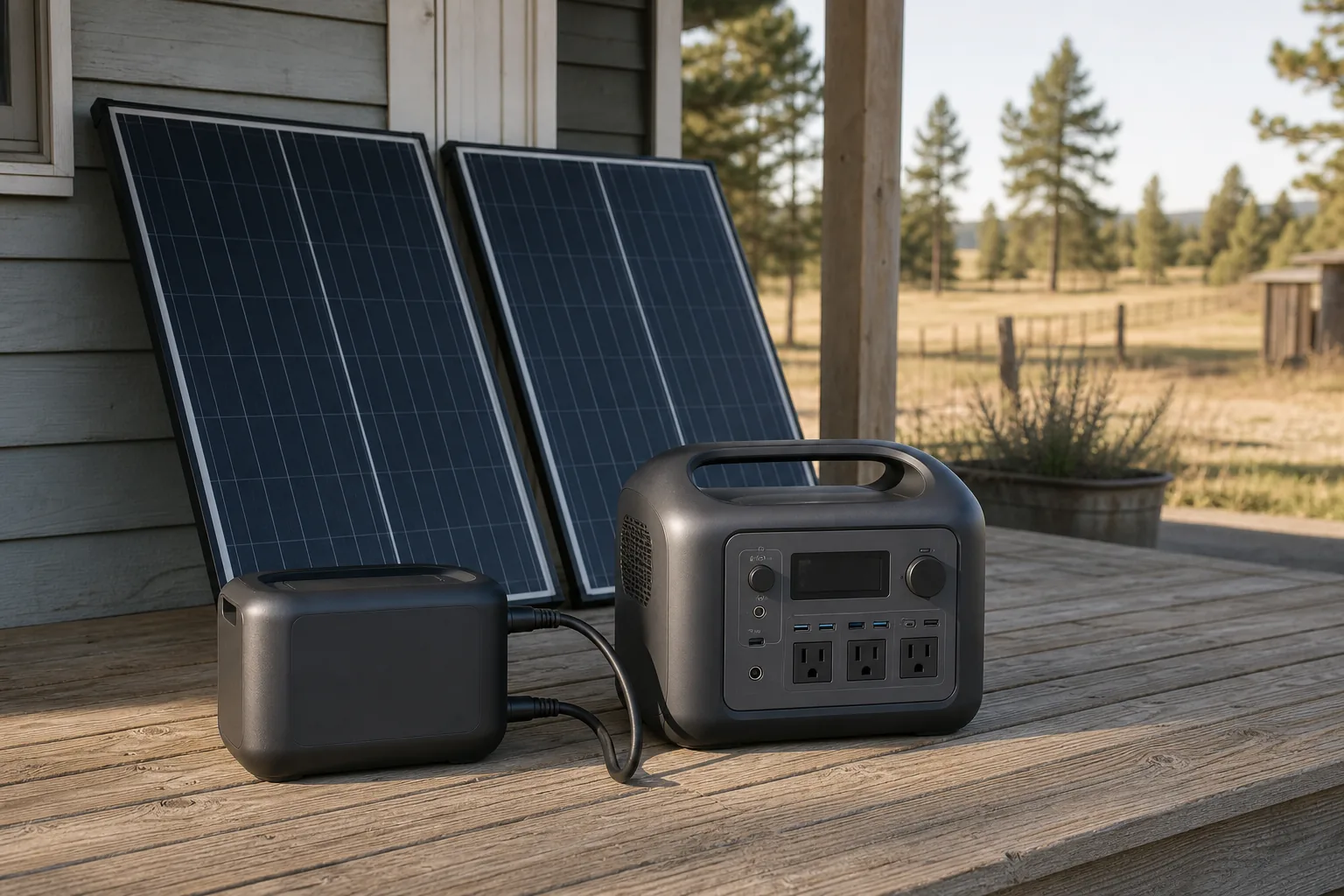
An expansion battery is a companion battery designed to connect to one specific solar generator or portable power station. It plugs into a dedicated input on the unit, and the generator’s built-in charger and battery management system handles it as part of the same system. The result is more stored energy between charges. Before you buy a solar generator expansion battery, the two things to confirm are the maximum number of batteries and the connector type.
That distinction matters. Adding an extra battery raises how long you can run a load, not how much power that load can draw. Output stays capped by the unit’s inverter. A 1,200 W generator with two extra batteries still outputs 1,200 W; it just runs longer. If your need is more simultaneous power, the answer is a bigger unit or a second generator, not another battery module.
| Characteristic | Expansion battery | Standalone battery |
|---|---|---|
| Connection | Dedicated input on the generator | External terminals (12 V / 24 V / 48 V systems) |
| Charging | Managed by the built-in charger and BMS | Needs its own charger or solar charge controller |
| Compatibility | Usually brand- and model-specific | Works with any system wired to the same voltage |
| Typical use | Extending a portable power station | Whole-home or cabin energy storage |
Most of these batteries use lithium iron phosphate (LiFePO4) cells, chosen for cycle life and thermal stability. The store stocks LiFePO4 battery banks and portable power stations from authorized brands such as Goal Zero, Bluetti, Jackery, EG4, and Renon Power, alongside hybrid inverters and solar panels that pair with them. A single 400 W solar panel can add a useful recharge rate to that setup, though panel output depends on sun hours and angle. A compact 1 kWh bank is a common entry point for adding storage capacity without buying a whole new generator.
2How many expansion packs can your solar generator take?
The limit is set by the unit’s battery management system and its maximum input current, not by the number of input ports on the side. Every expansion port carries a current rating you should match. In an off-grid system, the same rule applies whether the battery is a portable expansion unit or a fixed bank. Most manufacturers publish a hard cap, often expressed as a maximum added capacity in kilowatt-hours or a maximum number of batteries per unit.
Two numbers in the manual tell the story. The first is the max charge current from the input: every battery you add shares that budget. The second is the BMS’s total capacity limit: exceed it and the system refuses the extra battery, or in some designs, derates charging.
| What to look up | Where it appears | Why it matters |
|---|---|---|
| Max added capacity (kWh) | Specifications table | Hard ceiling on what you can add |
| Max batteries per unit | FAQ or compatibility notes | Some units cap at 1–2, others accept 4+ |
| Input current (A) | Charging / input specs | Defines cable sizing and charge speed |
| Operating temperature | Specifications | Charging below freezing can be blocked by the BMS |
If the manual does not state a limit, contact the manufacturer before buying a second battery. A mismatch between two BMS protocols is the most common reason an expansion system fails to charge. This is also worth checking when you compare brands: some systems are designed to be expandable from day one, while others are not.
3Expansion battery cable gauge: what actually matters
Size the DC cable by current and run length, not by the battery’s rated watt-hours. An undersized cable drops voltage under load, slows charging, and heats up. The ampacity values below come from NEC Table 310.16 for copper conductors, the same table licensed electricians use for DC runs.
| Cable (copper) | Max ampacity | Typical use for DC runs |
|---|---|---|
| 14 AWG | 15 A | Short runs, low-current batteries |
| 12 AWG | 20 A | Most single-battery connections |
| 10 AWG | 30 A | Larger batteries, medium runs |
| 8 AWG | 40 A | High-current battery modules |
| 6 AWG | 55 A | Long runs at high current |
Ampacity is only half the calculation. Voltage drop grows with cable length: for longer runs, step up one or two gauges even if the current looks fine. As a rule of thumb, keep voltage drop below 3% for DC circuits; beyond that, loads can brown out and charging slows noticeably. [A VERIFIER] exact voltage-drop target varies by manufacturer guidance; verify against your unit’s manual.
4Usable Wh vs. rated Wh: why the number on the box isn’t the whole story
Rated watt-hours are the total energy stored in the battery. Usable watt-hours are what the BMS actually lets you draw, and they are always lower. Two factors explain the gap: depth of discharge limits and system overhead.
LiFePO4 cells are typically rated for 80% depth of discharge in consumer batteries, and the BMS cuts off before the cells are fully drained to protect them and preserve cycle life across many charge cycles. A smart BMS also tracks state of charge and temperature while the battery sits in the system. On top of that, the inverter and electronics consume a little power themselves, and discharge efficiency is not 100%.
That is a generic illustration using the common 80% depth-of-discharge figure for LiFePO4, not a specification for any particular battery. The real ratio depends on the rated DOD, temperature, and load. When you compare options, compare usable capacity numbers, or apply the DOD factor yourself. A battery with lower rated Wh but a higher allowed DOD can deliver more real runtime than a bigger one with a stricter cutoff. Weight and physical size matter too when you plan where the extra battery will sit.
Our product pages state rated capacity in watt-hours, and the team can confirm the usable-capacity figure for any battery bank we sell before you commit.
5Sizing your expansion: a 4-step method
Work backward from the loads, not forward from the battery. Four steps, in order.
Example: a 200 W chest freezer that runs 8 hours a day uses 1,600 Wh per day, or 1.6 kWh. With an 80% usable ratio, that means 2,000 Wh of rated added capacity — and you still want headroom for cloudy days if solar panels are your only recharge source on an off-grid setup. Choose a battery that covers your daily number plus a margin; enough for two days is a sensible target for a solar-powered emergency backup.
If you are unsure how much capacity your setup needs, the store offers free system design consultation. Send us your load list and we’ll walk through the arithmetic with you before you spend on a battery. For a whole-home off-grid solution, size each battery bank the same way.
6Common mistakes when adding an expansion battery
Three mistakes account for most failed expansion projects.
What goes wrong — and the fix
- Mixing brands or generations. Batteries from different brands, or different generations of the same brand, often speak different BMS protocols. The system may charge at reduced speed or not at all. Fix: match the exact battery model your manual lists as compatible.
- Ignoring the input-current limit. Adding batteries beyond the input’s current budget extends capacity but not charge speed, so recharge time climbs. Fix: check the max charge current and plan recharge time around it.
- Undersizing the cable. A thin cable on a long run means voltage drop, slow charging, and heat. Fix: size by current and distance, then verify with a multimeter under load.
One more set of features worth checking before you order: does the unit support fast charging through the same input you plan to use? If not, the extra capacity still charges, just slower — which changes how you plan an emergency recharge day off-grid.
7FAQ
How many expansion batteries can I add to my solar generator?
It depends on the model. The limit is set by the unit’s battery management system and is usually published as a maximum added capacity in kilowatt-hours or a maximum number of batteries. Some portable units accept one or two; larger modular systems accept several. Check the specifications table in your manual, and if it is not stated, ask the manufacturer before buying.
What size cable do I need for an expansion battery?
For a portable generator with a proprietary input, use the cable the manufacturer supplies — that is the safest option. For a standalone battery wired to a system, size the copper cable by current and length: 14 AWG is rated at 15 A, 12 AWG at 20 A, 10 AWG at 30 A, and 8 AWG at 40 A per NEC Table 310.16. For long runs, step up one or two gauges to limit voltage drop.
Can I mix expansion batteries from different brands?
Usually not, and you should not try. Extra batteries rely on a specific BMS protocol and connector, so mixing brands can prevent charging or damage the battery management system. Use only the battery model your generator lists as compatible. If you need more capacity than one brand offers, consider a larger unit or a separate standalone battery bank instead.
Planning to recharge that extended capacity? Off Grid Vault carries rigid solar panels sized for off-grid and backup setups, like the Rich Solar Mega 250. If you are comparing battery banks or portable power stations, our team can confirm usable capacity and battery limits before you order — browse the catalog or ask us directly.
Sources
· NEC Table 310.16 allowable ampacities (National Electrical Code, NFPA 70) — NECA-IBEW reference table, consulted August 2, 2026.
· Lithium iron phosphate battery characteristics — Wikipedia, consulted August 2, 2026.
· Brand playbook (product categories, brands carried, 30-day performance guarantee).


